AI Governance • Strategy
Rethinking Privacy Operations in the Age of AI Agents
Subali Advisory
|
February 2026
AI Governance • Strategy
Operationalizing a privacy program involves distinct roles and complex functions. We have the Data Protection Officer (DPO), who ensures rules are followed, and the Privacy Program Manager (PPM), who executes programs across business units. Historically, this has been a manual, resource-heavy endeavour.
However, with the advent of "Agentic" technologies like @Anthropic’s Claude AI Agents —now equipped with task-automating protocols—many of these functions can be automated, significantly reducing both cost and timeframes.
The PPM’s first mission is data discovery. You cannot protect what you don’t know exists. In a modern enterprise, data is scattered across structured databases (SQL, Oracle), unstructured files (PDFs, emails), and SaaS applications (Salesforce, Slack). This presents significant "Context and Location" challenges.
A spreadsheet containing 9-digit numbers could be a high-risk list of Social Security Numbers or a zero-risk list of Product SKUs. Furthermore, "Shadow IT"—like an employee’s unofficial Dropbox—often hides sensitive data from traditional scanners. Because an enterprise is a living entity, a single developer adding a new field can make a static data inventory obsolete overnight.
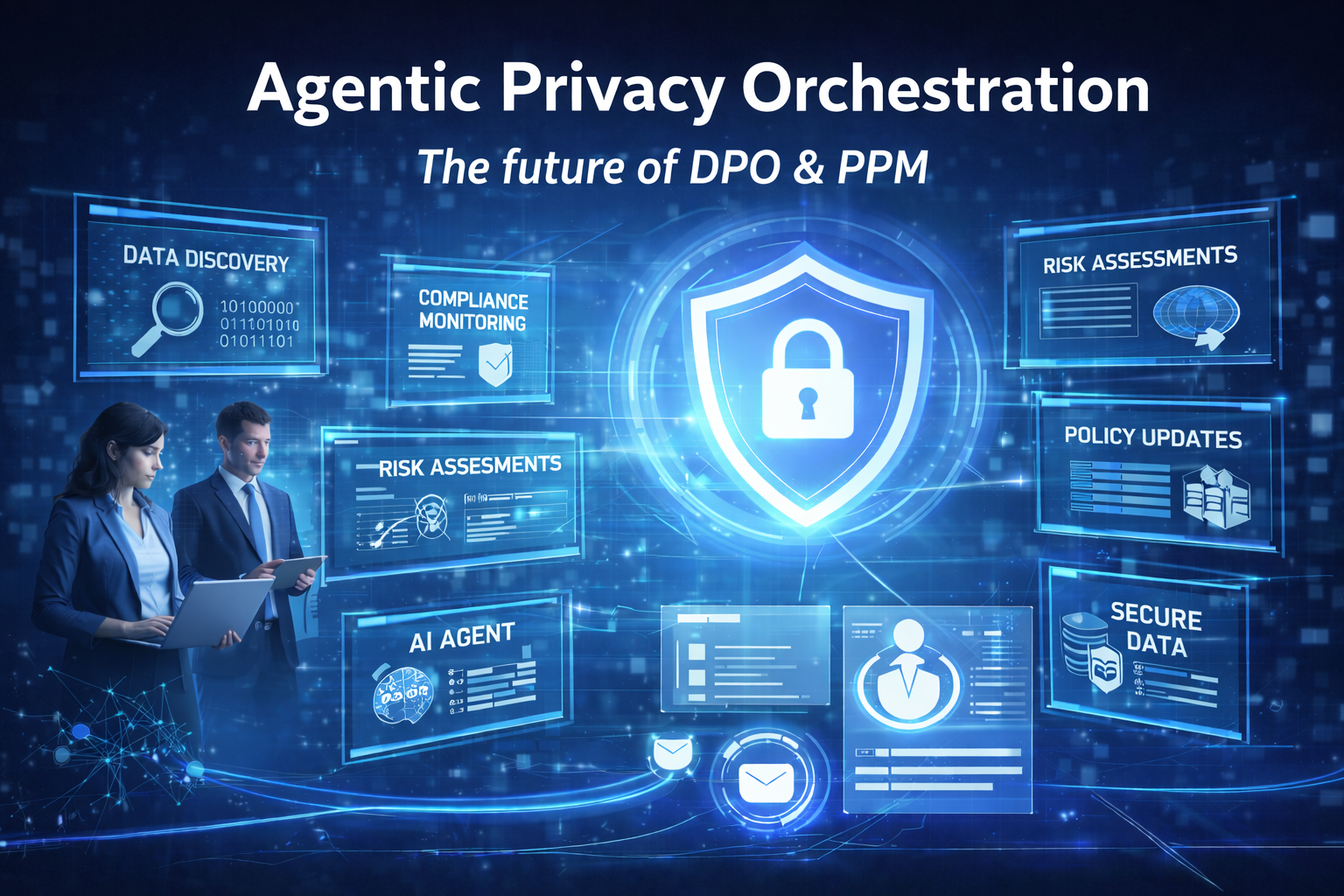
With the release of co-working AI Agents, complex tasks like Discovery, maintaining a RoPA, performing DPIAs, and fulfilling Subject Access Requests (SARs) can be automated and performed repeatedly. This is not "Privacy in a Box"; rather, these agents start with a baseline of general knowledge. They have already "read" the GDPR and understand frameworks like NIST and GAPP. Think of them as digital interns. You don't need to write code to direct them; you interact with them in plain English.
The breakthrough here is the Model Context Protocol (MCP) recently released by @Anthropic and “The Plumbing”. It acts as a universal translator between the AI and your enterprise data. Your IT team can run local MCP servers that give the agent secure access to your cloud (AWS/Azure/GCP), databases (Snowflake/SQL), and email servers.
These servers are set up with "Tools" (also known as Capabilities). For instance, a Tool named lookup_user_by_email allows the agent to verify a requester's identity. The agent doesn't just look for keyword matches; it performs a reasoning step. When you ask it to "check if a user is registered," the agent uses Intent Analysis and Semantic Mapping to select the correct tool based on its description.
"Scan the Inbox. If you find a SAR, verify the sender's email. If verified, search our SQL and Email servers for all records associated with that User ID. Redact any third-party names or 'confidential' internal comments. Compile the output into a PDF using our SAR_Template, but do not send it. Save it for my review and notify me on Slack."
From Building to Orchestrating: This shift has changed the very nature of privacy software. The dashboard is becoming secondary to the instruction. As a DPO or PPM, you don’t need to write code—you own the requirements. You tell the "Orchestrator" what you want, and the AI decides which tool to use.
We are moving rapidly toward Vertical Agentic Service Providers (VASPs). Instead of buying traditional management software, organizations are deploying agents that come pre-trained on privacy law and pre-configured with the necessary "plumbing."
As the law requires a "Human-in-the-Loop," we are seeing a new breed of consulting firms. They don't just sell software; they sell Managed Agentic Services. They deploy proprietary agents to do 90% of the operational heavy lifting, while the human experts provide the essential legal oversight.